Abaqus tutorials Abaqus tutorials
The four-point bending test is a widely adopted experimental and numerical method for evaluating the flexural performance of reinforced concrete (RC) beams, particularly when investigating advanced cementitious materials such as Ultra-High-Performance Geopolymer Concrete (UHPGC). This test configuration is especially suitable for studying crack propagation, flexural strength, ductility, and load–deflection behavior under a constant bending moment region.
Ultra-High-Performance Geopolymer Concrete combines
Geopolymer binder technology (low Portland cement or cement-free)
Very dense microstructure
High compressive and tensile strength
Enhanced durability and chemical resistance
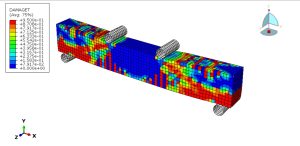
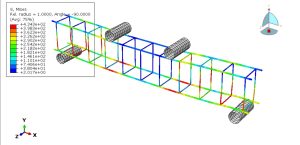
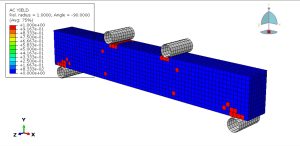
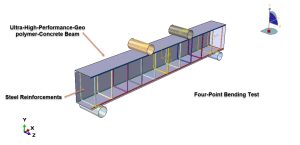
When reinforced with steel bars, the composite action between UHPGC and reinforcement significantly influences flexural response, making numerical modeling essential for deeper insight. You can see a figure of the assembled parts below
Finite Element Modeling in Abaqus
To simulate the four-point bending behavior, you modeled the UHPGC RC beam using Abaqus with the following constitutive approaches
Concrete Damage Plasticity (CDP) Model for UHPGC
The CDP model is appropriate for quasi-brittle materials and captures
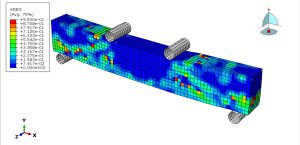
Tensile cracking, Compressive crushing, Stiffness degradation, Damage evolution under cyclic or monotonic loading
For UHPGC, defining accurate post-peak softening and fracture energy is critical due to its strain-hardening or brittle-to-quasi-ductile response, depending on fiber content
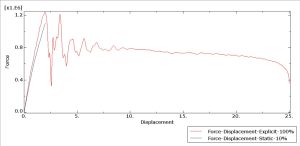
Two analysis procedures were compared
Static General (implicit) — efficient for quasi-static loading, but may face convergence issues with severe damage
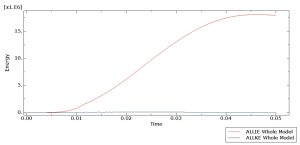
Dynamic Explicit — more robust for highly nonlinear cracking problems, but computationally intensive and requires quasi-static control