Abaqus tutorials Abaqus tutorials
Concrete-filled steel tube (CFST) shear walls have been widely applied in high-rise and seismic-resistant structures due to their excellent load-bearing capacity, ductility, and energy dissipation performance. By combining the advantages of steel and concrete, CFST systems effectively delay local buckling of steel tubes while enhancing the compressive strength and confinement of the concrete core. As structural design evolves toward larger spans, higher axial loads, and more complex architectural layouts, innovative cross-sectional configurations of CFST shear walls have attracted increasing research attention
Among these configurations, multi-cavity T-shaped CFST shear walls represent a promising structural form. The T-shaped cross-section offers improved out-of-plane stiffness and efficient material distribution, making it particularly suitable for core walls and perimeter structural systems. The introduction of multiple cavities within the steel tube further enhances confinement efficiency, improves stability of the steel plates, and allows for better control of stress distribution under axial compression. Compared with conventional single-cavity or rectangular CFST shear walls, the multi-cavity T-shaped design can achieve higher load-bearing capacity and improved deformation performance while maintaining architectural flexibility
Understanding the axial compression performance of such CFST shear walls is essential, as axial load is a dominant action in high-rise buildings and significantly influences overall structural behavior. However, due to the complex geometry, steel–concrete interaction, and nonlinear material behavior, experimental investigation alone is often limited by cost and fabrication constraints. Consequently, numerical simulation methods, particularly finite element (FE) analysis, have become an effective and reliable approach for investigating the axial compression behavior of multi-cavity T-shaped CFST shear walls
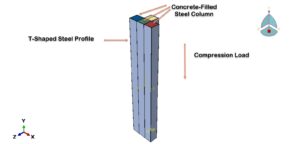
In this study, a detailed numerical model is established to simulate the axial compression performance of CFST shear walls with a multi-cavity T-shaped cross-section. The simulation considers material nonlinearity of steel and concrete, contact interaction between the steel tube and concrete infill, and geometric nonlinearity under increasing axial load. Key performance indicators, including load–load-displacement response, stress distribution, confinement effects, and failure modes, are analyzed. .
The results of this research aim to provide deeper insight into the mechanical behavior and load transfer mechanism of multi-cavity T-shaped CFST shear walls under axial compression, and to offer valuable references for structural design, optimization, and future experimental studies
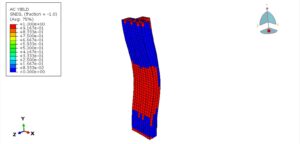
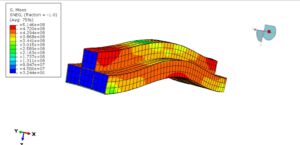
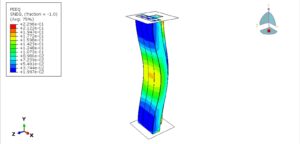
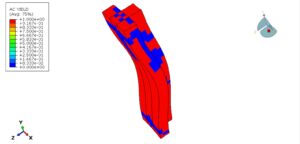
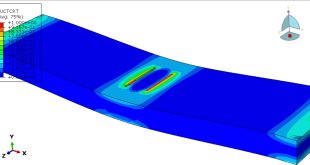
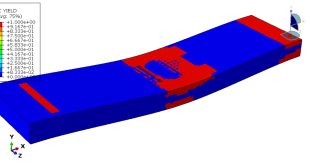
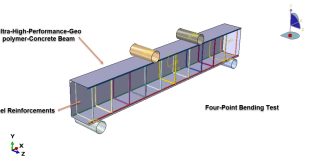
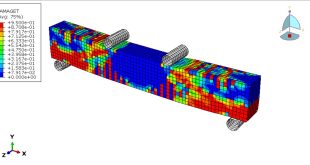
In this example, all members are modeled as three-dimensional parts. The Concrete Damaged Plasticity model is a good choice to represent the correct behavior of concrete under compression load. You can see the results of the simulation below