Abaqus tutorials Abaqus tutorials
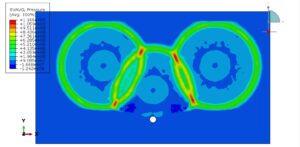
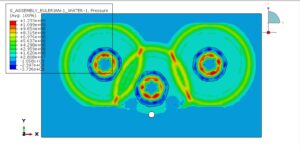
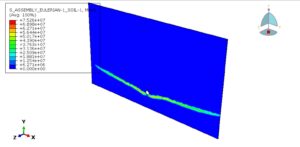
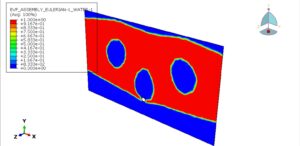
A Coupled Eulerian–Lagrangian (CEL) analysis of an underwater explosion near a pipeline is a numerical simulation approach widely used in nonlinear dynamics and hydrodynamics to model how shock waves and bubble effects from an explosion interact with nearby structures
Modeling underwater explosions (UNDEX) is challenging because the event involves extreme pressures, rapid fluid–structure interaction, large deformation, and material failure. Traditional numerical methods struggle to handle both the expanding explosion bubble and the structural deformation of the pipeline at the same time
The Coupled Eulerian–Lagrangian (CEL) method, commonly implemented in software such as Abaqus/Explicit, LS-DYNA, and ANSYS
Eulerian domain (water, explosive gases, and the surrounding fluid environment)
The mesh is fixed in space, and the material flows through it. This avoids mesh distortion during the violent displacement of water and the detonation bubble
Lagrangian domain (pipeline and soil or structural components)
The mesh deforms with the structure, allowing stresses, strains, plastic failure, and damage to be accurately computed
By coupling these two domains, CEL enables a realistic prediction of how the underwater blast’s pressure wave interacts with the pipeline.
CEL avoids mesh distortion problems common in pure Lagrangian approaches and allows the simulation to run efficiently and stably while resolving detailed pressure fields and structural responses
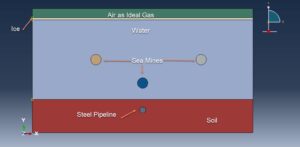
During this course, you will learn how to analyze a Coupled Eulerian–Lagrangian (CEL) underwater explosion near a pipeline in Abaqus through a practical tutorial. The training covers topics such as Eulerian part definition, the JH-2 material model for ice, the JWL model for TNT, ideal gas behavior, the Us–Up equation of state, Mohr–Coulomb plasticity, explicit step setup, boundary conditions, material subroutines, and results interpretation.