Abaqus tutorials Abaqus tutorials
Masonry walls are among the most widely used structural elements in residential, commercial, and heritage construction worldwide. Composed of masonry units (brick, block, or stone) bonded with mortar, these walls exhibit complex mechanical behavior due to their heterogeneous and anisotropic nature. Understanding their structural response under different loading conditions is essential for ensuring safety, serviceability, and seismic resilience
The analysis of masonry walls typically considers three primary loading scenarios: compression loading, transverse (out-of-plane) loading, and cyclic loading. Each loading type induces distinct stress distributions, deformation mechanisms, and failure modes
Under compression loading, masonry walls primarily resist gravity loads transmitted from floors and roofs. Their compressive strength depends on the properties of masonry units, mortar strength, bond quality, and workmanship. Failure under compression may occur through crushing of units, mortar joint failure, or vertical splitting caused by lateral tensile strains. Slenderness ratio, load eccentricity, and boundary conditions significantly influence compressive performance and stability
Cyclic loading simulates repeated or reversing loads, most commonly associated with earthquakes or dynamic wind actions. Under cyclic effects, masonry exhibits stiffness degradation, strength deterioration, and progressive damage accumulation. In-plane cyclic loading can produce diagonal shear cracking, sliding along mortar joints, rocking of wall piers, and eventual collapse. The hysteretic behavior of masonry walls is crucial for evaluating energy dissipation capacity and seismic performance
You can see a figure of the assembled parts below
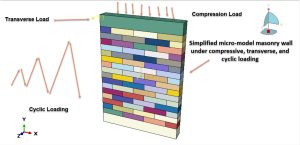
In modern structural engineering practice, integrating material characterization, advanced modeling techniques, and performance-based design approaches is essential for accurately predicting masonry wall response under compression, transverse, and cyclic loading conditions. In the present study, the brick masonry material was modeled using the Concrete Damaged Plasticity (CDP) model to capture the nonlinear inelastic behavior of masonry under different loading conditions. Although originally developed for concrete, the CDP model is widely adopted for masonry due to its capability to represent key phenomena such as tensile cracking, compressive crushing, stiffness degradation, and irreversible damage. A static general analysis step was employed to simulate the structural response of the masonry wall under monotonic and quasi-static loading. This approach is appropriate for compression and transverse loading cases, as well as for low-frequency cyclic loading where inertial effects are negligible. The load application was controlled incrementally to ensure numerical stability and to accurately trace the nonlinear load–displacement response up to failure. The interaction between masonry components (brick units and mortar joints, or brick-to-brick interfaces in simplified micro-modeling) was defined using a cohesive contact formulation.
The combination of the CDP material model, static analysis procedure, and cohesive interface interaction provides a robust framework for simulating the nonlinear mechanical response and damage progression of masonry walls subjected to complex loading regimes. After the simulation, all results are available
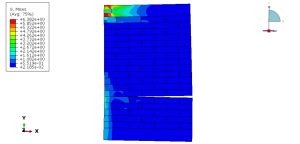
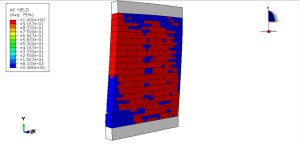
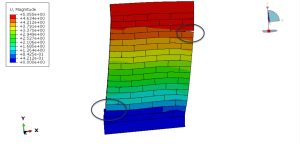
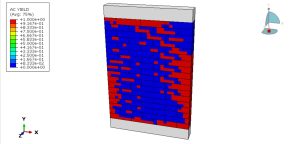
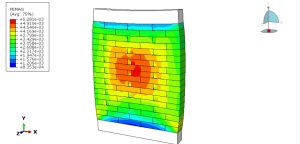
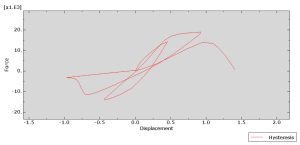
You can provide this simulation’s CAE, INP, and English video files here. The price of these files is Thirty Euros. You can click on the button below to begin the process
Our Payment methods are: Tether, Bitcoin, TRX, PayPal, Visa, or Mastercard. Just before payment, send us an email to this address: abaqusfem.com@gmail.com